
Terminal Terminology
Using Inclusive Language to Improve Passenger Experience eLearning
Overview
This scenario-based eLearning concept project helps airline gate agents explore the importance of using appropriate language to build empathy and express genuine interest for passenger concerns in order to improve customer experience and reduce escalation. It provides opportunity for airline gate agents to gain clarity of when to apply specific language when serving a diverse customer base during the boarding processes.
Audience: New and experienced airline gate agents
Responsibilities: Action mapping, storyboarding, visual & graphic design, eLearning development & instructional design
Tools Used (to date): MindMeister, Google Docs, Miro
This scenario-based eLearning solution followed the basic principles of ADDIE to determine the course goals and objectives during initial analysis. Following initial information gathering sessions with SMEs and stakeholders, the project was executed using SAM to ensure rapid prototyping and continuous feedback from the client. Being a certified Scrum Master, I value using Agile methodology in the development of learning solutions.
The Process
Analysis
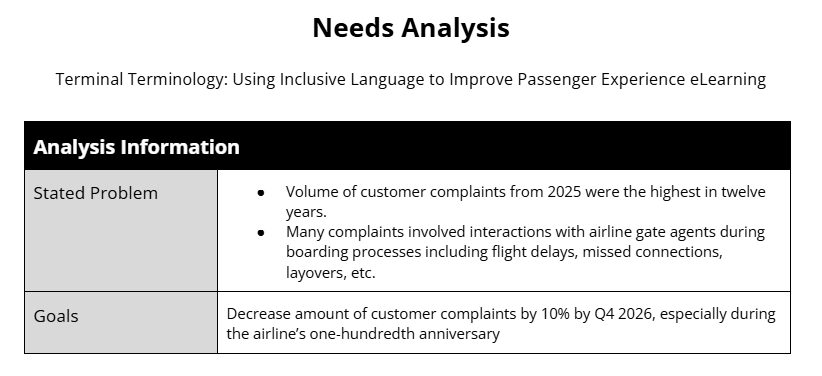
The client is one of the primary commercial air travel providers in the United States that recently introduced the slogan “Forever Forward” to celebrate its one hundredth year anniversary. With this new campaign came the need to better understand how to meet the needs of frustrated passengers who did not have positive experiences at the airline gates.
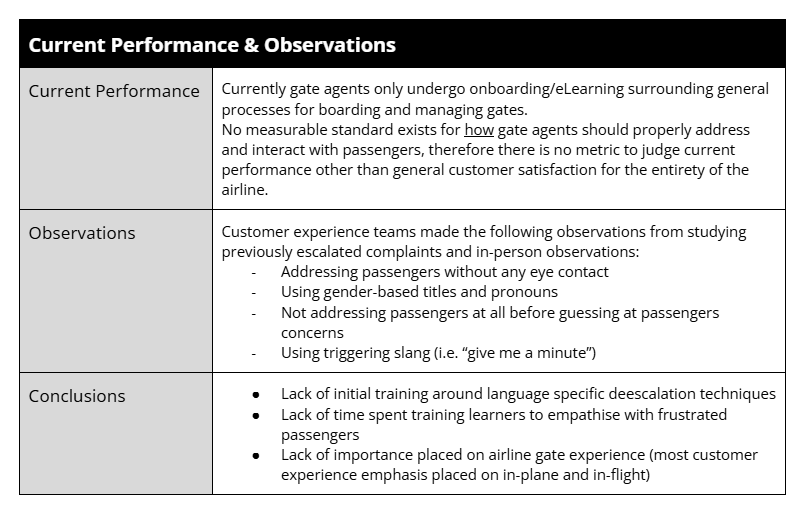
Many airline passengers experience frustration and negative emotions that can affect their interactions with airline gate agents. Since time management is so important during boarding processes, airline gate agents often take a direct approach with passengers, and while well-intended, this can sometimes backfire, especially for passengers who are frustrated and feel ignored.
The team needed a scalable and engaging solution to help airline gate agents practice empathy-informed skills in real-world scenarios. By partnering with the Customer Experience (CX) management experts, we identified a need for opportunities to use inclusive language with passengers. Although essential to quality customer experience, gate agents often receive only basic conflict management training without opportunities for targeted practice focusing on language and empathy.
The Problem
The Solution
By partnering with the Customer Experience (CX) management experts at this airline company, we identified a need for opportunities to use inclusive language with passengers. Although essential to quality customer experience, gate agents often receive only basic conflict management training without opportunities for targeted practice focusing on language and empathy.
This new scenario-based eLearning training will empower gate agents to build empathy and trust with passengers to reduce escalation and ensure a smoother gate and boarding experience.
The eLearning trainings solution I developed consists of:
A reference hub – Providing access to this airline’s customer service principles, key resources, and a course specific job aide for on-demand reference.
A three-module, scenario-based eLearning simulation – Allowing airline gate agents to practice inclusive conversations in a low-risk environment, adapting to increasing difficulty levels with mentor tips, feedback and decision-based consequences.
This demo highlights the first module of the eLearning simulation, showcasing how learners engage in passenger conversations and the consequences of their communication decisions. Parts of the training have been modified due to demo purposes.
Action Map
To ensure this eLearning solution would be based on real-life scenarios, I created this action map with the guidance of members from the CX management team who acted as subject matter experts (SMEs). We identified the business goal would be to decrease gate-specific complaints filed with customer service representatives by 10% by Q4.
I lead the process of translating some of the most common customer complaints into an action-based framework that learners could take to improve passenger interactions using positive, inclusive language and empathy while shying away from any perceived microaggressions in speech.
The first high-priority action for this course became the first decision point in Module 1, ensuring learners avoid obvious pitfalls when initiating conversations with passengers.
Design (IN PROGRESS)
Text-based Storyboard
The action map guided the development of a text-based storyboard using Gagne’s Nine Events of Instruction as well as Bloom’s Taxonomy to create objectives. To model realistic interactions, I worked with SMEs to design a scenario where airline gate agents address airline passenger concerns during a flight delay.
Project in Progress
*
Project in Progress *
Please check back soon for more updates.